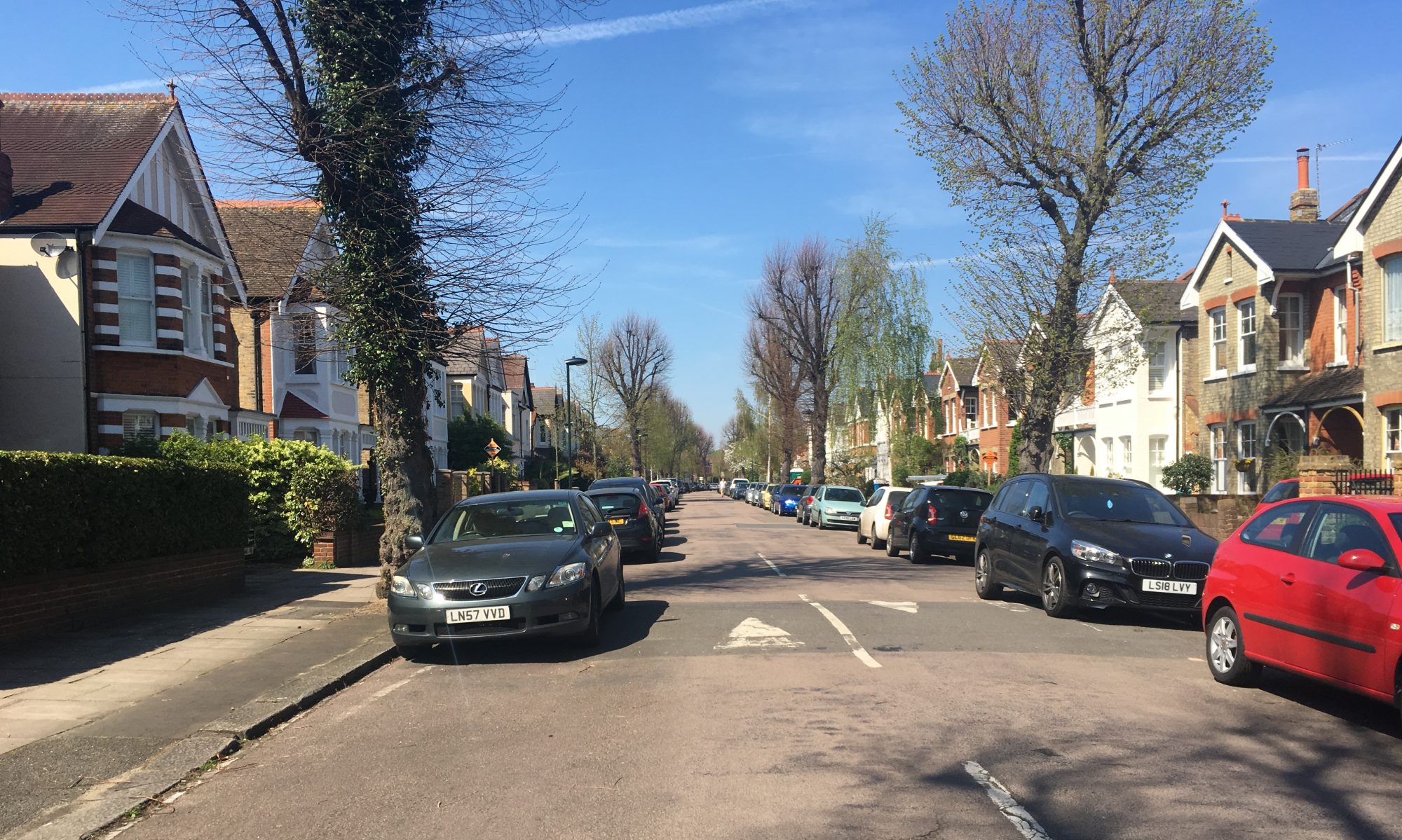
Langham Road in Teddington was built across the grounds of the Teddington Place Estate, which was itself located in the area bounded by Kingston Road, Ferry Road / Teddington High Street and Kingston Lane. This website aims to trace the changes over time that led to the road we know today. Please add any comments here.

Timeline
Before 1660
Teddington became a manor at some time well before the Norman Conquest. It belonged to Benedictine monks located in Staines who it is believed were the first to build a chapel dedicated to St Mary on the site where the church stands today. In turn, the manor of Teddington, formerly part of the ‘Hundred of Spelthorne’ along with Staines and Shepperton and the manors in between, was apparently gifted to the new abbey of St Peter (which later became Westminster Abbey) in AD785 to help provide finance for the new abbey to be built.2,4,8,10,11,15

In 1536 the manor was surrendered to Henry VIII by the Abbot of Westminster in exchange for property in Berkshire, and Teddington became part of the ‘honor’ of Hampton Court. Both the Abbey and the Crown leased the manor out to various families. What is now Langham Road sat within a field belonging to the manor known as Southfield (260 acres in size by c1665).2,4,8,10,11,15
In 1603 the freehold was granted to John Hill, an Auditor of the Exchequer, and the Hill family remained lord of the manor for some generations. At this time the lord of the manor owned nearly all the land in the parish, but certain parcels of land were sold over time as ‘copyhold’. (Property was ‘surrendered’ to a new owner who paid a fine to the lord of the manor and was ‘admitted’ to the property.)4,8
1665 – 1682
A copyhold property was first built on the site of Udney Hall Gardens in c1665 by John & Anne (or Anna) Croftes.1,6
In 1675 Charles Paulet, Marquis of Winchester acquired the property from Anne (or Anna) Croftes. He was visited there in 1679 by King Charles II.1
1683 – 1711
Charles Duncombe (one of the richest men of his day, a goldsmith and Lord Mayor of London in 1709) acquired the property in 1683 from Charles Paulet – a house, barn, stables, garden, orchard and two acres of land near St Mary’s Church. Some sources suggest that Charles pulled down most of the properties and built a house on the site, others that he altered and decorated the existing main property. It became known as Teddington Place. Duncombe employed Grinling Gibbons to carve some of the woodwork, and Verrio to decorate the ceilings – both of whom had been working at Hampton Court.6,7,18,21
Charles then set about acquiring a sizeable estate in Teddington, generally from friends or acquaintances:
- At the same time as he acquired his initial property in Teddington, Charles acquired an adjacent property from William Stowe (whose wife had inherited it from her father Benjamin Garfield). A house with yard, orchard, stables plus arable land and a meadow1
- Later in 1683, Charles acquired two more properties – a tenement with barns, stables, garden and orchard from Ephris Bishop, plus another house from Richard Chandler1
- At the manor court in Teddington in 1686, John Cox surrendered to Charles a house with ten acres of land. John had inherited this from his late father, James (Jacob) Cox. The property was located on the southern side of the High Street opposite Twickenham Rd1.
- In 1689 James Cox (brother to John) surrendered a further seven acres of land to Charles, to the north west of Teddington Place. The land contained a house later known as Faversham House1
- In 1701 Charles acquired from John Clarke three acres on north side of Teddington High St to the west of Twickenham Rd (possibly now the site of Peg Woffington cottages); three ‘messuanges’ and 32 acres from Henry and Ariana Joyce – again on the north side of the High St and 2 acres from Elizabeth Clarke including a close near Teddington Place1
- In 1702 Charles acquired from Abraham Clarke a cottage, garden and orchard adjacent to Teddington Place and located directly opposite St Mary’s Church1
In 1701 a poem about Teddington Place called “Tuddington House” was published by one of Charles’ neighbours – Francis Manning.1
1711 – 1716
Charles died at Teddington Place in 1711 and left his estate to his two nephews:
- Anthony Duncombe (1695-1763), son of Charles’ brother Anthony, who got the Teddington properties amongst other bequests.
- Thomas Brown (1683-1746), son of Charles’ sister Ursula, who inherited the Helmsley estate plus other properties, and who then adopted the name Duncombe. He later built Duncombe Park at Helmsley.
Charles’ mother Mary (nee Pawley) continued to live at Teddington Place until her death in 1716.1,18
1717
Anthony and his wife Margaret (nee Verney) were recorded as living at both Teddington Place and another one of their inherited properties – Barford House in Wilshire1.
1744 – 1762
From around 1744, some reports indicate the popular Irish actress Peg Woffington to be living at Teddington Place, and having some almshouses built nearby – now known as Peg Woffington cottages. Other accounts record her as living in the cottages. Peg appears to have moved out of Teddington Place by 1755 and was buried in 1760 at St Mary’s.9 (Weekly Irish Times, 14 Dec 1907, The Star Guernsey, 2 Apr 1885)

In 1747 Anthony was created Lord Feversham, Baron of Downton . Then in 1755, his first wife Margaret died. By then Teddington Place was being leased by Sackville Tufton, the 8th Earl of Thanet.9
The following year Anthony married The Hon Frances Bathurst, but she died in 1757, and a couple of years later Anthony married his third wife – Ann Hales, niece to Dr Stephen Hales, vicar of St Mary’s on Ferry Road.18
1763 – 1777
In 1763 Anthony died, leaving Teddington Place and other property inherited from his uncle to his second cousin Thomas Duncombe (son of the Thomas who built Duncombe Park). However the will was challenged and in 1777 the Court of Chancery declared that the surplus of Anthony’s estate not already dispursed belonged to his widow Anne and his two surviving daughters: Frances (daughter of Frances) and Anne (daughter of Anne) – the three to benefit from rent and profits from the estates.1,18
In 1765 Anthony’s widow Anne was re-married to William Bouverie, second Viscount Folkestone who later became the first Earl of Radnor.1,18
In 1777 Anthony & Anne’s daughter, Anne, married William’s son Jacob Pleydell-Bouverie who had become the 2nd Earl of Radnor on the death of his father the previous year.18
c1779 – 1783
Teddington Place was leased to John St Leger Douglas Esq, who was a Member of Parliament and owned sugar plantations on St. Kitts. John’s main residence was Springfield Place near Chelmsford.1,18
1783 – c1803
The Douglas family continued to occupy Teddington Place after John St Leger’s death in 1783. His son William appears to have taken over the tenancy. 1,18
Anthony’s widow Anne died in 1795, leaving Anthony’s two surviving children, Anne Radnor and Frances Bowater, as the beneficiaries of the estate when the common fields were enclosed in 1800. At the time this comprised 20 acres (including Teddington Place, Peg Woffington Cottages, Church House in Twickenham Road and Feversham House) and they received an allotment of over 100 acres. Teddington Place was still being leased by William Douglas, his wife Harriet and 8 young children.2,18
1804 – 1806
Teddington Place was by now occupied by the Dowager Duchess of Essex. (London Courier & Evening Gazette, 1 Oct 1804)
At the Teddington Manor Court in 1806 it was reported that land tax payments on the Feversham Estate in Teddington were overdue and that part of Anthony Duncombe’s estate, including Teddington Place and its park, another house and premises with a coachhouse and stables should be sold. Teddington Place was ‘surrendered’ to William Devon, possibly a solicitor.1
1810
The question of ownership of the lands claimed by Anthony Duncombe’s daughters was raised again at the Teddington Manor Court. Subsequently the remaining Teddington properties were divided into 6 lots and sold to Thomas Woodrouffe Smith, the lord of the manor, and to Charles Devon (son of William) who purchased lots 4 & 6.1
c1815 – 1830
By 1815 Teddington Place was being leased by John Calvert Clarke Esq, originally a master clothworker, distiller, and later a director of the Albion Insurance Company and investor in the Phoenix Gas Company.17,18
In 1819 William Devon died. Teddington Place, along with William’s other estates, was inherited by his son Charles.18
John’s lease ended in 1830 and was marked by the sale of his furniture. (Morning Advertiser, 18 Jun 1830)
1830 – c1851
Charles Devon is documented as living at Teddington Place in 1833 on the birth of his son. His wife and children were living there at the time of the 1851 census, although Charles was staying in a gamekeepers lodge in Rackenford, Devon.17,18
Several adverts were published seeking tenants for Teddington Place. In an 1834 one, Teddington Place was described as ‘recently repaired and improved’ (Morning Post, 8 Sep 1830, London Courier & Evening Gazette, 31 May 1834).
c1854 – 1856
In 1854 Anthony Ward Ritson was recorded as living at Teddington Place on his sons birth certificate. Then again in 1856 when his daughter was born. He ran a railway contracting company and appears to have worked on the construction of a number of railways across the country.18 (The railway line going through Teddington opened in 1863)
1857 – 1874
In 1857 Sir James Langham took the lease on Teddington Place. It appears to have been leased on his behalf by his brother, Herbert Langham who was immediately in dispute with Mr Ritson and Mr Devon over repairs needed to the property. Correspondence concerning the state of the property continued until the end of Sir James’ tenancy.11
Sir James was the the 11th Langham Baronet of Cottesbrook Park, a large estate in Northamptonshire. He had married in 1828 and lived with his wife at Glyndebourne, but shortly after the marriage his wife “awoke from her bed in a fright and threw herself from the window”.18 (Dublin Morning Register, 21 February 1829). Sir James seems to have never recovered from that, and appears to have always had medical care / family on hand in Teddington.17
In 1861, James’ sister Henrietta and her husband Arthur John Otway (3rd Baron Otway of Brighthelmstone) were shown in the census as staying with James, and appear to have continued living at Teddington Place for some time with their children. In the 1871 census, Sir James was recorded as a ‘lunatic’. By this time, the Otways were no longer shown as residing at Teddington Place (although Mrs Otway seems to have remained involved in the ongoing dispute) having been replaced by a medical attendant.17,18
Charles Devon died at his property in Kent in 1869, and Teddington Place was inherited by his eldest son, Henry Charles Devon.18
The following year Henry visited Teddington Place and complained about the condition of the house and grounds but stated that he would still like Sir James as a tenant. The dispute over the state of Teddington Place rumbled on into 1872 when a wall collapsed. There was a disagreement over who should pay to repair: Henry or the Langhams.11
This map (held by the National Library of Scotland) shows the area around that time.
1874
In 1874, Sir James’ furniture and effects were advertised for sale, having been removed from Teddington Place.(Surrey Advertiser, 18 Jul 1874)
Teddington Place estate was put up for sale in 6 lots: Teddington Place & grounds, Faversham House & grounds, Church House, 4 cottages opposite Faversham House (Peg Woffington cottages), a parcel of land near Shacklegate Lane and a nursery garden near Fulwell Station. Teddington Place however remained unsold.12

1877 – 1878
Teddington Place was re-advertised for sale of lease in 1877 and again in 1878. It was now also being referred to as the Udney Hall Estate. (The Standard, 20 Jun 1877)
Newspaper reports state that Arthur Otway was again in residence on being elected as MP for Rochester in 1878. (The Globe, 15 Jun 1878)
1881 – 1885
Udney Hall and grounds was apparently “secured” in 1881 as a site for the Zephyr Club – a swimming club (The Surrey Comet, 16 Apr 1881), but no further reference can be found to this.
The 1881 census shows that Udney Hall was being occupied by George Phillips, the gardener “in charge of Udney Hall”. George appears to have continued living at Udney Hall until at least 1884 when he appeared in court on charges of assaulting his wife! (The Surrey Comet, 13 Sep 1884).
Also in 1881, the National Liberal Land Company was registered declaring its aim to purchase and develop freehold estates (Staffordshire Sentinel, 31 Mar 1881).
In April 1882 Teddington Place (house and grounds) was sold to Samuel Thomas Turtle and George Appleton of Spenser House, New Wandsworth13.
The National Liberal Land Company appears to have purchased the Udney Hall estate soon afterwards and mortgaged it to the Hon Montague Mostyn and his brother-in-law Roger Eykyn. By 1883 the company had marked out a new road across the estate (Langham Road). The site (excluding the main house) was now referred to as the Teddington Weir estate and freehold building plots were being advertised for sale by auction (The South London Press, 30 Jun 1883; 3 Nov 1883). It appears this was not without controversy in the local community though (The Surrey Comet, 24 Nov 1883).
By 1883 Udney Hall house was in a poor state as evidenced by a letter to the paper (Surrey Comet, 24 Nov 1883). It was presumably planned for demolition as the original plot map for the estate shows that the land now occupied by the Landmark Centre and Udney Hall Gardens was originally offered for sale as individual plots with a road proposed across the area from Langham Road to Kingston Road13.
Plots continued to be advertised in 1884, 1885 and 1886 (The South London Press, 12 Apr 1884; The Surrey Comet, 2 May 1885; 26 June 1886).
1885 – 1896
In 1885 Udney Hall was purchased from the National Liberal Land Company by Edward Dobree, a shipbroker. He made further purchases of adjoining land in 1888 and 1889, and continued to live at the house until his death.2,13,16,18
In 1887, work started on Teddington Footbridge.
Also in 1887 the foundation stone was laid for a new church in the former grounds of Teddington Place. (The vicar of St Mary’s, F Leith Lloyd, wanted a larger church for his congregation, and engaged William Niven to design this enormous church at a cost of £30,000. It looks like a Gothic cathedral with its flying buttresses; however an intended west tower was never built. The church was consecrated in 1896.)

This map (held by the National Library of Scotland) shows the area in 1893/4.
1902
Contracts were awarded by the local authority for the roadworks to make up Langham Road. (Surrey Comet, 19 Jul 1902).
Later that year plans for the tramway through Teddington were published, necessitating considerable alterations to the road layout where Langham Road meets Ferry Road / the High Street (Surrey Comet, 25 Oct 1902).
1928
A picture taken in 1928 shows Udney Hall alongside St Albans Church.
1937 – 1960
Edward Dobree died in March 1937, leaving probate to his son Edward Awdry Dobree, shipping agent, and son-in-law Thomas Reginald Bond, stockbroker. In May the contents of Udney Hall were put up for sale by the executors and in June, the house was purchased by Middlesex County Council. 13,18
The Council then started correspondence about leasing Udney Hall and its grounds to Twickenham Council for use as open space / pleasure ground, pending the land being required for the purposes of the construction of the approach road for the proposed bridge over the River Thames at Teddington planned for at least 8 years in the future. Correspondence between the two councils continued for some years. The County Council wrote to the Borough Council stating that the proposed road would probably go through the house, and that they might like to consider demolishing it. Further correspondence from Twickenham Council suggested that the County Council should take responsibility for demolition. The house was described as an eyesore. Twickenham Council however refused to take over until the house had been demolished.10
In 1939, it was agreed that the house should be used as an air raid precautions store and Twickenham Council pulled out of the agreement to take on as open space.10
At some point between October 1940 and June 1941 a high explosive bomb fell on Kingston Lane, at the back of Langham Road. See here for map .10
In 1942 the Council erected a hut in the grounds for training wardens and fire guards and by 1947 Udney Hall was no longer in use for Civil Defence. It was finally agreed that the County Council would demolish the house and Twickenham Council would lease the grounds for open space until such time as bridge was built. Udney Hall was demolished that year, and the grounds which once contained the house became a small park – Udney Hall Gardens .10
By 1959 Middlesex had dropped the idea of a bridge and Udney Hall Gardens was finally sold to Twickenham Council.13

1960 – 1995
Owing to a falling congregation, St Alban’s Church was made redundant in the 1960s and St Mary’s once again became the parish church. St Alban’s sat neglected and unused for many years, although in 1985 it was used for the music video of ‘The Sun always shines on TV‘ by 1980s pop group a-ha.
A campaign led by local people eventually succeeded in saving it from demolition in order to build flats on the site, and in 1995 it became the home of a new community art centre – the Landmark Arts Centre – funded by the sale of land for building flats on the perimeter.

If you have any comments, additional information or corrections please let us know here.
 Langham Road